

The Agony of an Ingrown Toenail
The Agony of an Ingrown Toenail
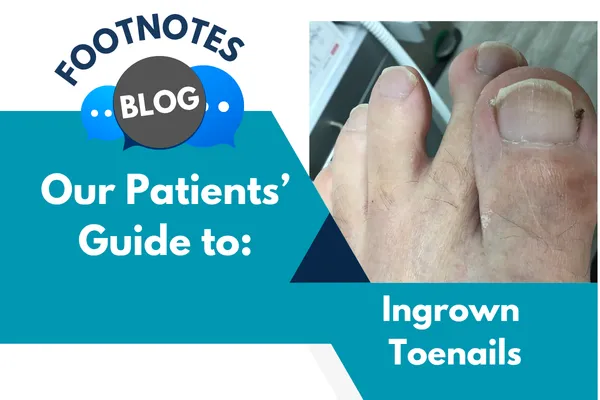
Why do some nails become ingrown? From mild discomfort to a full-blown, red, throbbing, weeping toe, an ingrown toenail can make life miserable and stop you from doing the activities you love.
Common causes
Broad nail plate + tight shoes
Some people have a broad nail plate, and the edge can become embedded in the side of the toe (sulcus), particularly when wearing tight shoes.
Warm, sweaty feet
When feet are warm and sweaty, the softened skin is more easily broken by the pressure of a nail.
Children and thin nail plates
Young children can be more prone to ingrown nails because their nail plates are very thin and have sharp edges. It's like giving yourself a papercut.
Sport and football boots
Playing sport - footballers, in particular, have a triple whammy: the pressure from kicking the ball, plus snug-fitting football boots, plus soft, sweaty skin.
Curled/involuted nails
Some people have curled or ‘involuted’ nails, and the nail acts like a pincer, squashing the toe along one or both sulci. These can cause pain without actually growing into the sulcus. But they can be tricky to trim because the edge of the nail is hidden. It is easy to leave a small shard at the edge of the nail, which then pierces the sulcus towards the tip of the toe.
Poor nail trimming technique
Don’t cut nails too short. The nail needs to extend over the toe, finishing just shy of the tip. One of the functions of nails is to provide an opposing force to the ground when you take a step. Otherwise, the ground reaction force pushes the fleshy tip of the toe upwards, producing a bulge that the nail can grow into.
And don’t cut down the sides. When you can’t see the edge of the nail, it is all too easy to leave a shard in situ.
Can I treat an ingrown toenail at home?
If caught in the early stages, soaking in warm, salty water can ease the swelling and discomfort. Then you can carefully ease the toe away from the edge of the nail.
Attempting to remove the nail yourself is really not advised, as it is very difficult to get close enough to your own toe to see what you are doing. If you create a wound, you risk developing an infection. And it will likely hurt if you attempt the procedure with standard nail scissors or clippers (or even a penknife, as one client admitted to!).
When should I seek help?
If the pain doesn’t settle after a few days of bathing, then it is best to seek help from a podiatrist. Untreated Stage 1 ingrown nails run the risk of developing into:
Stage 2 - tissue overgrowth develops along the nail's edge, accompanied by weeping and/or pus. This tissue, called hypergranulation tissue, is produced by the body as it tries to heal the wound caused by the nail.
Stage 3 - is a chronic ingrown nail in which the hypergranulation tissue starts to grow over the nail.
Treatment becomes more involved the worse the toe becomes.
At Kenilworth Footcare, we offer an Ingrown Toenail Assessment. We’ll take a full history, assess what’s going on and explain your options. You can book an assessment HERE.
What will a podiatrist do for an ingrown toenail?
We have very fine nippers and tools to extract the offending nail fragment with minimal discomfort. If the toe is too sore even for that, we can pop a small dose of local anaesthetic into the toe before we remove the piece of nail.
Nail avulsion: a permanent solution (when it's needed)
If hypergranulation tissue is established, or if you have repeated episodes of pain, then Nail Surgery (or another term is nail avulsion) may be the answer to provide a permanent solution. Under local anaesthetic, the edge of the nail is removed down to the nail bed, along with any hypergranulation tissue. The nail bed is then cauterised to prevent that piece of nail from growing again. Once healed, you are left with a narrower nail that looks perfectly normal.
Phenol vs laser cauterisation (healing time and infection risk)
For years, chemicals such as phenol have been used to kill the nail bed. While this is effective, the chemical burn can take a few weeks to heal. During this time, care must be taken to keep the toe clean and dressed to prevent infection. At Kenilworth Footcare, we are delighted to be one of the first clinics to offer laser cauterisation. Using a laser reduces healing time dramatically. The quicker it heals, the less chance of developing an infection. We have another blog which gives more information about the two methods:
How Does K‑Laser Nail Surgery Compare to Phenol, and Which Heals Faster?
Why antibiotics don't fix the problem
Antibiotics deal with the symptoms but don't address the root cause: a piece of nail is embedded in your toe, providing a portal for bacteria to enter. The antibiotics will kill the bacteria in the short term, but until that piece of nail is removed, the toe can’t heal, and bacteria can re-enter.
What to do next
If you are fed up of struggling with a painful ingrowing nail, give us a call on 01926 563555, or book your assessment HERE.
We'll take a full history, explain why you have developed an ingrown nail and discuss your options. We aim to relieve your pain as quickly as possible.
Further reading:
Understanding and treating ingrown toenails
How Does K‑Laser Nail Surgery Compare to Phenol, and Which Heals Faster?
The Kenilworth Footcare guide to nail surgery
NHS Conditions: Ingrown Toenails
Royal College of Podiatry: Common Foot Conditions - Ingrown Toenails
Contact Kenilworth Footcare:
📞 01926 563555
📍 2 Oaks Precinct, Kenilworth CV8 1DP
With free parking and ground-floor access. We're here to help you get back to the activities you love, comfortably and confidently.